August 25, 2019 – Rainbow Road (OOTD #554)

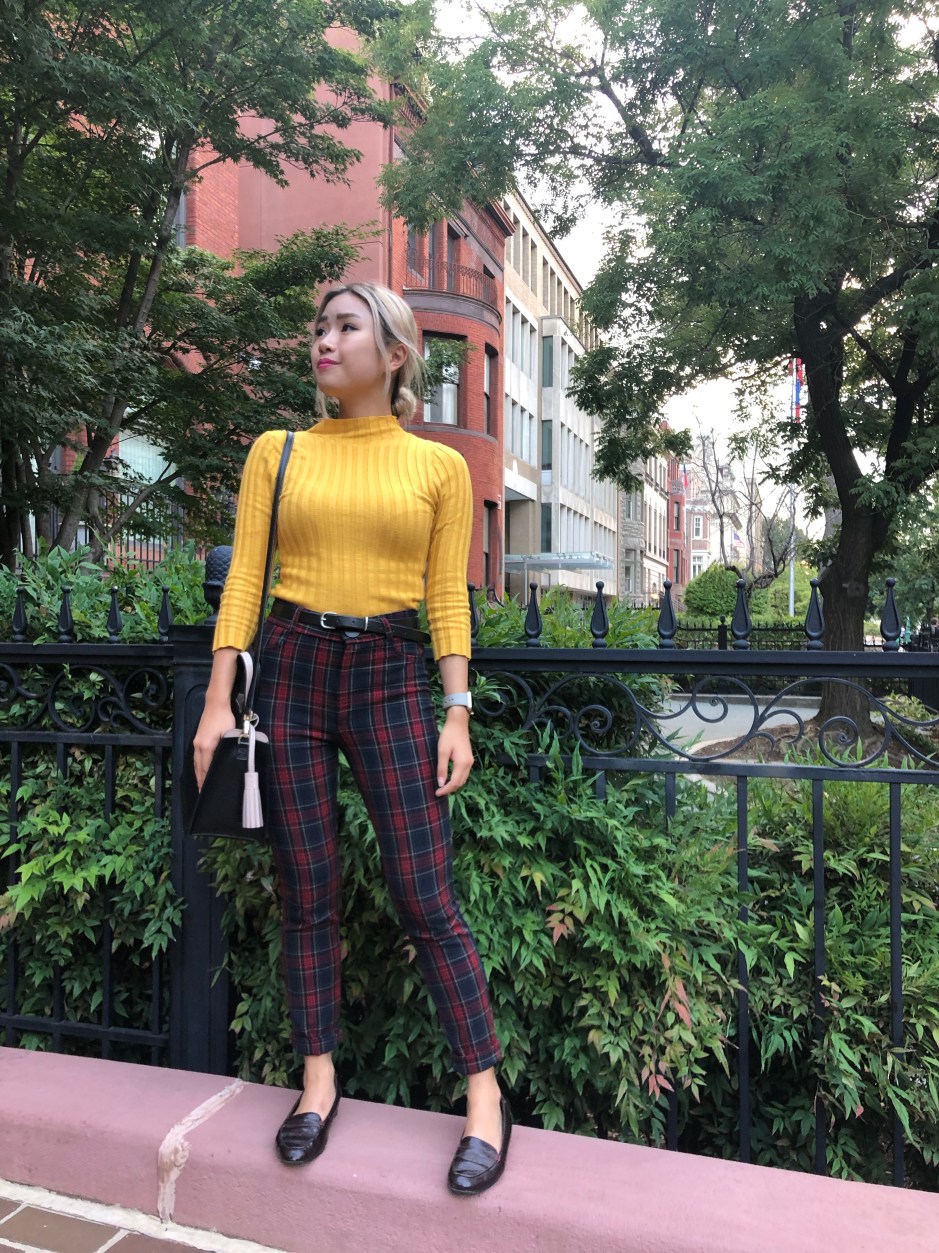
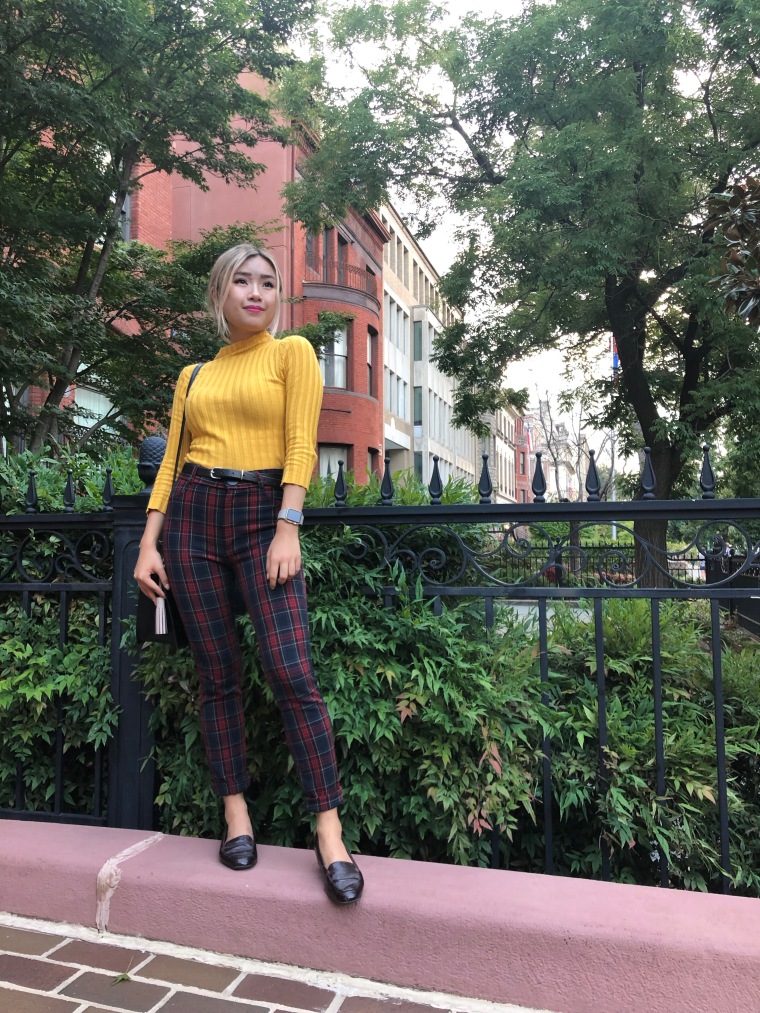
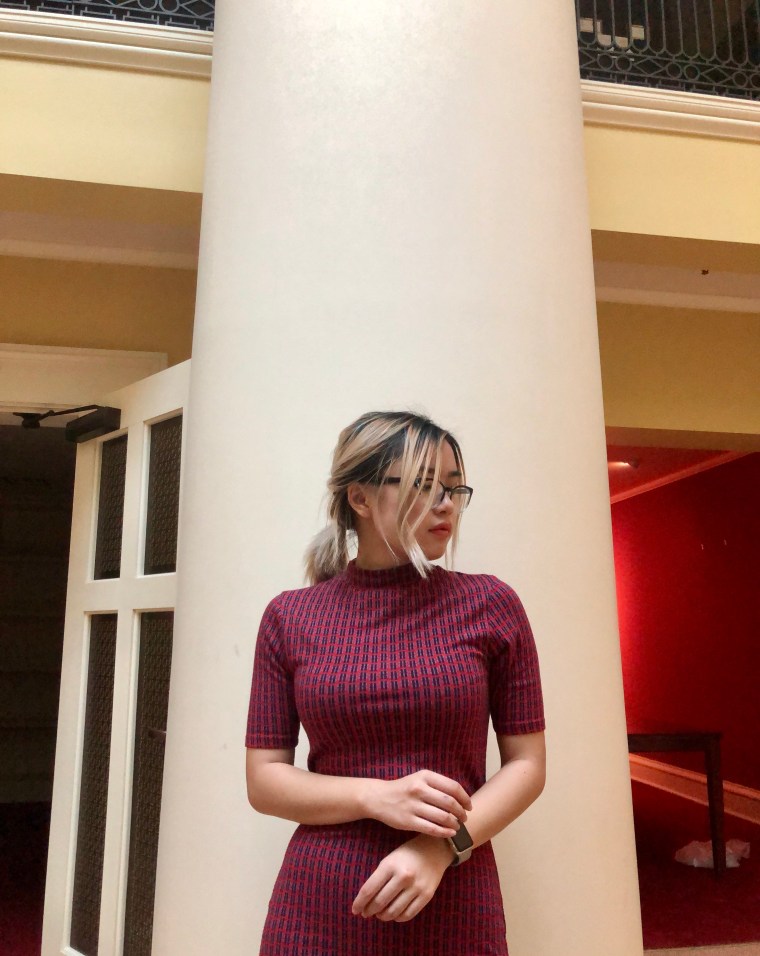
You know, if you squinted, this could almost pass for a part of Notting Hill in London.

Look, I’ll be up front about it: Washington DC is not my favorite city in the world. It’s not even my favorite city in the US. As much as I’m grateful to be here for the semester as a part of an internship program with Notre Dame and as much as I’m excited to be away from South Bend for a few months, my enthusiasm is more to do with what goes on in DC, rather than DC itself.

That’s about it for today. Thanks for reading, and I’ll see you in the next one with more updates on my life this semester in Washington, DC. Don’t forget to check me out on Pinterest, Instagram, Facebook, BloglovinTwitter, and Tumblr! For business inquiries, shoot me an email at lensembledujour@gmail.com!


Dress: Thrifted (the pile of abandoned clothing in my dorm room’s laundry room)

Jacket: Forever21

August 24, 2019 – The Washington Way (OOTD #553)

Finally, my actual location and the location that I’m writing about in my blogs match up again!

IMG_6539.jpeg

As I’ve mentioned before, the content I’m posting about in my blogs tends to be a bit behind (or, has been the case recently, quite behind) the date I’m actually posting it. For example, I’m writing this blog in late October, but it’s about something that happened back in late August. So in late August, I was moving in to my apartment in Washington, DC.

But wait, Washington DC isn’t in Northern Indiana! Isn’t there where I normally go to school? Why wasn’t I moving back into my dorm at Notre Dame in late August, along with all of my friends and the rest of the student body?

The answer: because I’m taking a semester away from Notre Dame to do a special program though the Political Science Department to take a full 15-credit semester course load while working an internship here part-time. Think of it like a study abroad semester — except of course, DC isn’t really abroad.

IMG_6574.jpeg

Unlike a semester abroad, however, I get to work (and in my case, get paid!) while maintaining my status as a full-time student. And at any rate, I get to go abroad in the spring semester anyway, so I really get the best of both worlds.

IMG_6541.jpeg

What I don’t get, however, is the third world: my friends back on campus at Notre Dame. I’m going to be away for a whole year, and that’s kind of saddening. Not saddening enough to prevent me from doing it (and honestly not even really saddening enough for me to give a second thought about whether I wanted to do it), but enough so to make looking at my friends’ Instagram posts of them moving back into the dorms a little bittersweet.

That’s about it for today. Thanks for reading, and I’ll see you in the next one with more updates on my life this semester in Washington, DC. Don’t forget to check me out on Pinterest, Instagram, Facebook, BloglovinTwitter, and Tumblr! For business inquiries, shoot me an email at lensembledujour@gmail.com!


Turtleneck: Forever21

Trousers: Zara


August 14, 2019 – How to Take Public Transport from Jerusalem to Bethlehem: A Traveler’s Guide (OOTD #547)

After a brief intermission featuring the World Holocaust Museum, it was back to research on the West Bank border graffiti.

After devoting my first full day in Israel-Palestine to taking a comprehensive tour with a Palestinian guide, all I had left in mind to do with the remainder of my time was go back on my own and have a closer look at the artwork. Easy, right?

IMG_5637

More like easier said than done. It shouldn’t have been as surprising to me as it was, but it’s rather difficult to travel between Israel and Palestine. It must have something to do with how the two regions don’t get along with each other (and haven’t for years), and how Palestinians are prevented by law from entering Israel and Israelis are prevented by law from entering Palestine. Just a wild guess.

As a foreigner, you are free to visit both — in fact, you’re even free to visit the Gaza Strip, though you probably shouldn’t unless you’re a specialized humanitarian aid worker. But just because you are free to visit the areas, doesn’t mean it’s a stress-free experience. In fact, for me, it actually was rather stressful because for the life of me, I couldn’t figure out how best to get from Jerusalem (on the Israel side) to Bethlehem (on the Palestine side) via public transport.

This guide ended up being rather useful for me, but as it turns out, it was a little over a year old and difficult to follow at points. I’ve decided to compile my own little guide below:

How to take public transport from Jerusalem to Bethlehem: A Traveler’s Guide (2019) 

Congratulations! You’ve decided to take some time out of your trip to Jerusalem to visit its neighboring city, Bethlehem. Lots of solo travelers visiting Israel miss out on visiting Palestine because of how difficult it is to get there without a tour guide to help you. Good on you for deciding to broaden your horizons and check out a part of Israel-Palestine that many don’t want you to see.

Though the two cities are right next to each other, they’re divided along political boundaries (and with a physical barrier called the West Bank border) that make taking public transport between them rather complicated. Whether you’re going to see the Banksy hotel or the Church of the Nativity, you can use this guide to get from Jerusalem city center to Bethlehem.

IMG_5547.jpeg

Note: when traveling between Israel and Palestine, always remember to carry your passport with you! You will need it to cross any checkpoints. Additionally, you never know when you’re going to be stopped by a police officer or soldier and asked to show your papers. The reality is that they use a lot of racial profiling to determine who to stop, so if you look definitively “foreign,” you may be less likely to be suspected of being a Palestinian trying to sneak into Israel (or vice versa), but it’s best to be safe! 

IMG_5566

  • From Jerusalem Old City, you’re going to want to head to Damascus Gate, the gate opposite Jaffa Gate, a common meeting point for tour groups. Just across the street from Damascus Gate, you’ll find the bus station for the Palestinian bus company, South Bus Company. South Bus Company is the only one that offers transport from Jerusalem into Bethlehem; the Jerusalem bus company, Egged, will get you near the border, but it cannot take you into Bethlehem. You can tell South Bus Company buses apart from Egged buses because South Bus Company buses are blue and white while Egged buses are green.
  • South Bus Company runs three routes from Damascus Gate:
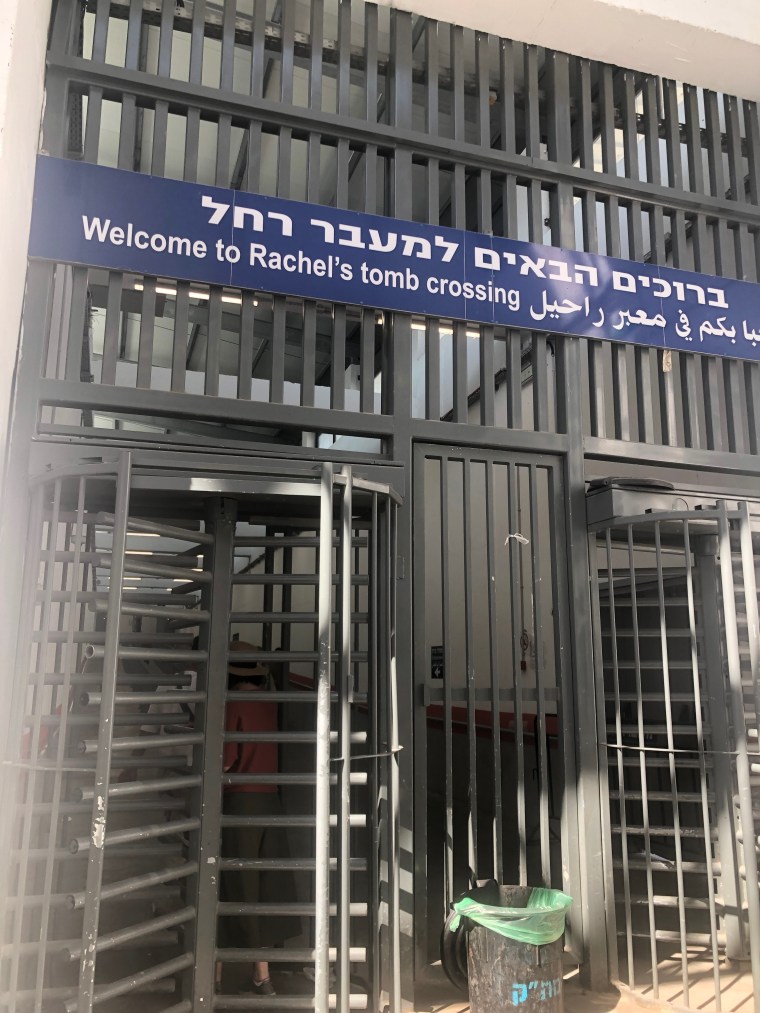
    1. The 234, “Checkpoint 300” (formerly the 24) — this bus travels from Damascus Gate to Checkpoint 300 (sometimes also known as the Rachel’s Tomb crossing). It does not technically go into Bethlehem. The bus will drop you off outside of the Checkpoint 300 terminal, at which you will have to cross the border on your own. This is what I did, as the 231 was not running the day I tried to visit. It’s a little scary at first, but with your foreign passport, the soldiers will hopefully not give you a hard time. They’re less concerned about people trying to get in to Palestine as they’re concerned about people trying to get out.
      • This is a good route to take if you’re only interested in seeing the West Bank border graffiti or the Banksy Hotel. They are within a 10 minute walk of the Checkpoint 300 exit. Use Google Maps to navigate you to the Banksy Hotel, and from there, you should be very easily able to follow the perimeter of the wall to see the art.
      •  Checkpoint 300 can be very busy depending on what time of day you visit! Try to avoid morning and evenings of weekdays, as many Palestinians will be crossing to leave for work/return home from work at these times
      • After you exit Checkpoint 300 on the Bethlehem side is a great place to grab a taxi, if you want one.
    2. The 231, “Beit Jala” (formerly the 21) — this bus travels from Damascus Gate to Bethlehem City Center, near the Church of the Nativity. This bus route does not require you to deal with Checkpoint 300 on your own, but you will still have to wait for the police to check the papers of every passenger. Because of this, you may be held up for some time. This is the route I tried to take, but for whatever reason, it was not operating that day, and I had to take the 234 instead.
    3. The 232, “Beit Safafa” (formerly the 22) — this was the route on which I was able to find the least amount of information. I know that it begins at Damascus Gate like the other two, but I was not able to find where it actually terminates. From what I could gather, I believe this bus may go all the way into Hebron, but I am not certain.
      • If you have any information on the 232 route, let me know and I’ll add it to the guide!
  • Fare for one trip is 5 NIS, or approximately 1.42 USD. You can only pay in cash.
  • Here’s South Bus Company’s official website that you can see the latest info on. They only have their website in Hebrew and Arabic, so use Google Translate if you need English (or another language). The site shows you routes and the schedules.
    • Note that in Palestine and Israel, the working week is Sunday-Thursday. From sundown Friday to sunrise Sunday, Jews (so, Israelis in particular) observe Shabbat, meaning that public transport in Jerusalem is not widely available. As a result, on the schedule, you’ll see Sunday-Thursday, then Friday and Saturday schedules.
  • Be mindful of time if you’re traveling very far into Palestine. Within Bethlehem and the rest of the West Bank, there are more checkpoints beyond the initial checkpoint crossing, depending on whether you are technically in Palestinian or Israeli territory. Each checkpoint has certain hours of operation, so you do not want to get caught on the wrong side of a checkpoint after it has closed!
    • Checkpoint 300, the main checkpoint for crossing between Jerusalem and Bethlehem, is supposedly open 24/7. However, I have also heard that Palestinians will queue for hours in early morning in order to ensure that they can get to work on time in the morning, so just because a checkpoint is permanently staffed, does not mean that processing will be efficient at all hours of the day!
  • To return to Jerusalem at the end of your travels, simply catch the bus again from where you got off. You will need to pay another 5 NIS fare. You can either ride the bus all the way back to Damascus Gate in Jerusalem or signal the bus driver (usually a wire to pull or button to press) that you want to get off at any of the stops in Bethlehem or Jerusalem along the way.

IMG_5734

Let me know if you have any particular questions or if there’s anything you think I need to elaborate on further! This is all just based on my experience over the summer; no guarantee of course that things will be the same when you visit. If you have any information to add based on your travels, please leave a comment!

That’s about it for today. Thanks for reading, and I’ll see you in the next one with more updates on my trip to Israel-Palestine this summer. Don’t forget to check me out on Pinterest, Instagram, Facebook, BloglovinTwitter, and Tumblr! For business inquiries, shoot me an email at lensembledujour@gmail.com!


Top: TJ Maxx

Trousers: J.Crew

August 12, 2019 – The Writing on the Wall (OOTD #545)

Here we are: the actual reason for my trip to Israel-Palestine!

I didn’t really discuss this in my blogs from last spring, but I spent a sizable chunk of time before spring break writing a grant proposal to go to Jerusalem to do some research. It was a long shot — I never thought I’d actually get the money to go, and I mostly considered it an experiment with the grant-writing process (which I had only done once before, to go to Vichy for a week-long language intensive in French) that would be useful practice for later.

The plan to go to Israel-Palestine stemmed from the time I’ve spent over the last two years working with the Madrasa Discourses project, for the conciliation of traditional Islamic thought with modernity in India and Pakistan. The idea first came from a friend that I made while in Doha with an MD conference. She was the one who originally proposed turning our experiences with Madrasa Discourses and interreligious dialogue into an independent project, and so I owe it to her for inspiring me to actually go through with the whole undertaking.IMG_5062.jpeg

Though she ultimately couldn’t go, which was a huge factor in determining my level of comfort going to a politically tense area like Jerusalem, I still decided to do it. You don’t get a grant from your university to do research every day — especially when the research takes you to a country and a culture you’ve experienced been before.

There have been many famous walls throughout history – the Great Wall of China, the Berlin Wall, the of Northern Ireland Peace Lines – and now a new barrier wall has joined their ranks.

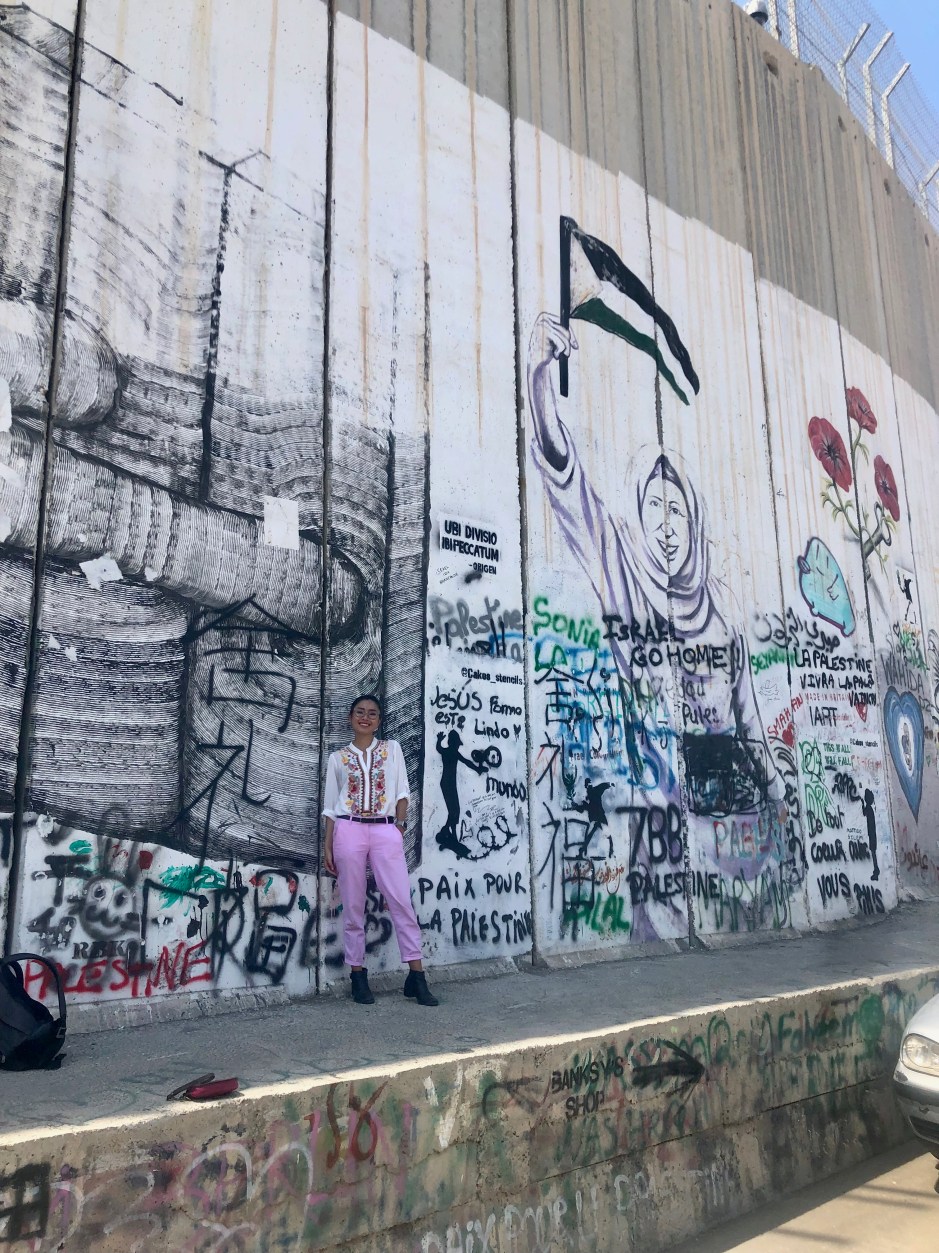
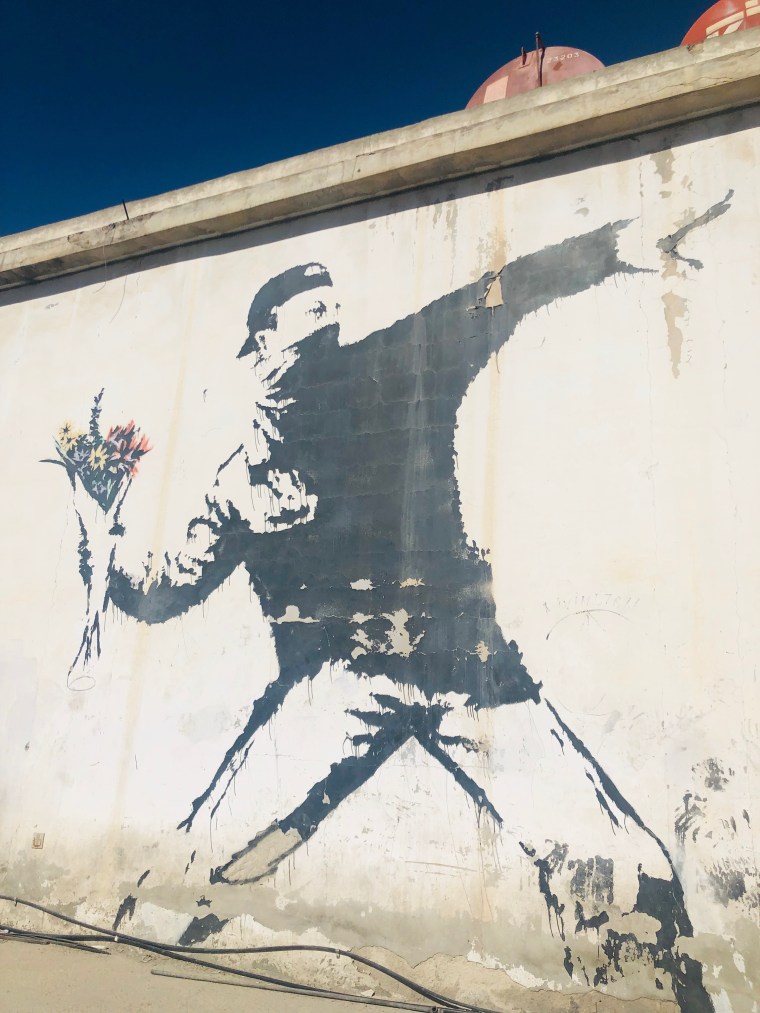
This barrier wall is the West Bank barrier, which separates the Muslim-dominant Palestine from the Jewish-dominant Israel. Described by Israelis as a “security fence” (geder-ha-hafrada) and by Palestinians as an “apartheid wall” (jidar al-fasl al-‘unsuri), the barrier has been a subject of controversy ever since its construction began in 2002. Out of controversy and political unrest, however, can spring one of the most passionate and creative forms of self-expression: art.
IMG_5070.jpeg

Much like what was seen in Berlin and Belfast, artists in Jerusalem have transformed the concrete that separates Israel and Palestine into a canvas for political discussion. On either side of these walls, activists, professional artists, and civilians have used graffiti as a way to express opinions about the situation in Israel-Palestine and the barrier’s existence.

During the course of my one-week journey to Israel-Palestine, I studied this political graffiti on the West Bank border wall, focusing specifically on the area around Bethlehem. My goal was to discover some of the artistic themes on the wall and how those reflected local sentiment about the ongoing Israel- Palestine conflict. More specifically, I wanted to study how the opposing narratives of the border wall as a “security fence,” as it is referred to by many Israelis, or as an “apartheid wall,” as it is referred to by many Palestinians, were evident in the wall’s artwork.

If you’re not familiar with the situation in Israel-Palestine surrounding the border wall, here’s a little context: the border was initially constructed by Israel to protect against extremist Palestinian bombings, and to many Israelis, it has done its job well. In 2004, approval of the wall for Jewish-Israelis was at 78%, with many arguing that it had caused the shift from nearly-weekly bombings in 2003 to only three attacks in 2004. IMG_5087.jpeg

However, though the barrier primarily follows the Green Line (a 1948 armistice border acknowledged by the UN), it swerves east several kilometers to incorporate certain Israeli settlements. To many Palestinians, this is nothing short of occupation and land grab. The wall cuts off many Palestinian citrus and olive farmers from their land, making it difficult or impossible for them to harvest their crops because of the new security checkpoints. Crossing the checkpoints from Palestine-controlled Bethlehem to get into Israel-controlled Jerusalem also poses many problems for Palestinians; people begin queuing hours in advance on weekday mornings so that they can get to their jobs in Jerusalem. Many simply bypass the checkpoints and cross the border illegally every morning instead — something Israeli employers easily take advantage of by refusing to pay “illegal” Palestinians for labor they have already completed.

With this background in mind, I began my preliminary research by taking a graffiti tour with a Palestinian guide. This initial tour was crucial, as he was able to point out key pieces of art (such as those by famous English graffiti artist Banksy) and direct me to other wall-related graffiti that was in the area but not necessarily on the wall itself. I came back at a later date to actually scrutinize individual pieces and photograph the wall itself; this first day was just to get my bearings with the help of a local. With this as my main goal for the day, I was able to relax a little and just enjoy learning.

IMG_5134.jpeg

Due to the constantly changing nature of graffiti, some of the pieces that I had seen online when I had been doing research for my grant proposal had been completely removed or covered by new pieces of graffiti. For example, one, which had previously depicted President Trump and Prime Minister Netanyahu in a kiss, had been altered to remove their embrace. It may be interesting to go again in a year or so to see how the visible graffiti has changed — which pieces have been scrubbed away, or covered up by other graffiti, or had their message altered.

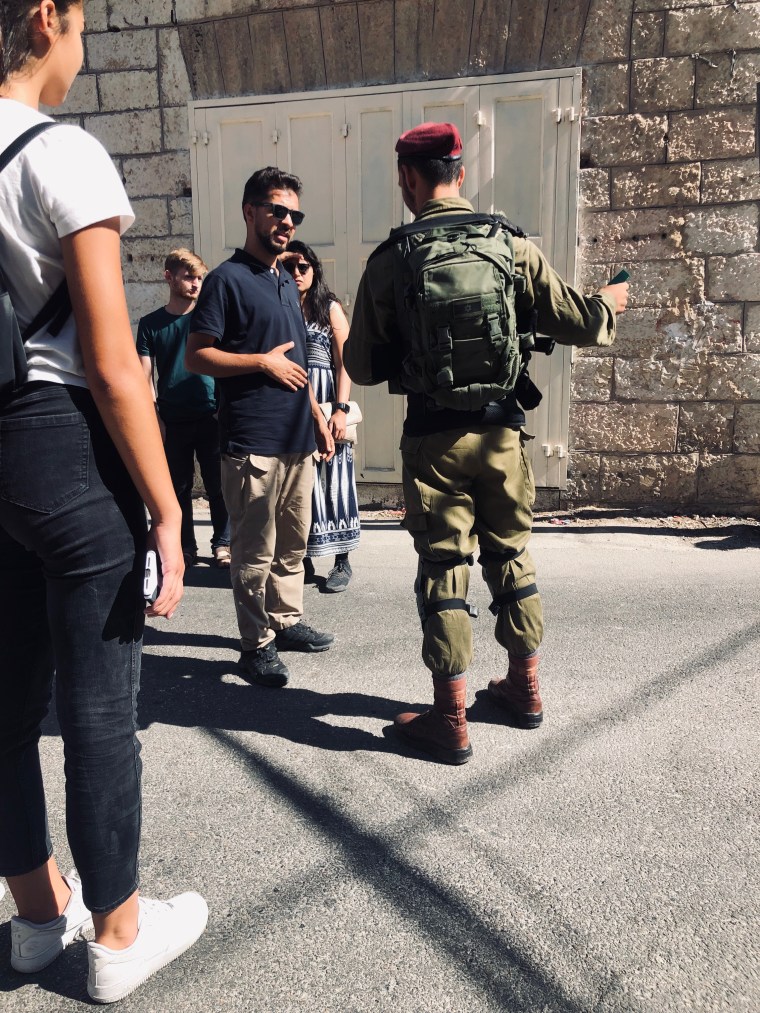
My guide also took me into Bethlehem to see a Palestinian refugee camp, where I got to talk to some locals (including an elderly man who rememberd when the Palestinians were orignally evicted from their homes in 1948 during what is known to Israelis as their War of Independence and known to Palestinians as The Nakba, meaning “the Catastrophe” in Arabic). Seeing the lives of Palestinians as they went about their days was honestly just as impactful as the graffiti. At one point, we had to cross into a piece of territory that was technically under the control of Israel. We, as foreigners, were allowed in but our Palestinian guide was stopped by IDF soldiers before he even got to the checkpoint.
IMG_5230.jpeg

But it wasn’t all politics and gloom — we visited a part of Hebron, where we saw a glassblowing workshop. We also saw the Church of the Nativity in Bethlehem, the (honestly, kind of tacky) Crusade-era church built to commemorate the supposed birthplace of Jesus. And we got lunch at a really lovely Palestinian cafe, which was still open despite the fact that it was a Muslim holiday and most places were closed.

IMG_5210.jpeg

When I originally wrote this grant proposal, I had hoped to learn about both sides of the Israel-Palestine conflict through the artwork on the wall. As it turned out, there wasn’t much artwork on the Israeli side at all, nor was there much artwork on the Palestinian side that might be described as “pro-Israel.” I thought that this might be the case going in — graffiti often being used more as a vessel for protest rather than praise — so my trip helped to confirm my belief.

Because I actually visited Palestine/the West Bank, rather than just viewing images of the wall online, I actually got a sense of what life is like for the Palestinians who live behind the wall. Perhaps most apparent was the great wealth disparity that was immediately visible as soon as I crossed from Jerusalem to Bethlehem. They feel like worlds apart — one is relatively safe, modern, and comfortable, and the other looks more like what you’d imagine a war zone in the Middle East to be. The massive concrete wall, guard towers, and IDF soldiers watching you from above doesn’t help.  

IMG_5132.jpeg  

Do I recommend that you go to the wall itself? Personally, I feel a little conflicted about the concept of political tourism, because actual people’s lives aren’t something to be gawked at and photographed like animals at a zoo — however, it’s critical to educate yourself about the history and political context of the places you go, and one of the best ways to do that is simply to pay a visit to a contested area. Each city has one– it’s Freedom Square in Budapest, it’s the Opéra in Vichy.

As the quote goes, travel is fatal to prejudice, bigotry, and narrow-mindedness. Respect the people you encounter, don’t treat it like it’s another tourist destination for Instagram, and share what you see if it so moves you to consider a different perspective or narrative than you thought you knew.

If you ever get the chance to visit Israel-Palestine, I highly recommend popping over to the West Bank to get the Palestinian story. Whatever you decide, do as the writing on the wall says, and “don’t be a brick in this wall.”IMG_5145


That’s about it for today. Thanks for reading, and I’ll see you in the next one with more updates on my trip to Israel-Palestine this summer. Don’t forget to check me out on Pinterest, Instagram, Facebook, BloglovinTwitter, and Tumblr! For business inquiries, shoot me an email at lensembledujour@gmail.com!


Top: Zara

Coat: Forever21

Trousers: Altar’d State

Sunday Musings – September 2019 Bullet Journal Spread (in October…)

Oof, it’s been a really long time since I’ve posted one of these. 

Look, I’ve been busy. I’ve been to seven different countries and three different continents in the time since I last posted a “Weekly Musings” or a bullet journal post. I finished my sophomore year, finished an internship in South Bend, finished an internship in Rome, finished a research trip to Israel-Palestine, and made it halfway through an internship in Washington DC.

And it’s not like you missed out on much in my bullet journaling. I did a spread from April, and it actually turned out quite nicely, but I haven’t done a spread since then. Maybe I’ll post the April one a little down the line — a sort-of bullet journal #throwbackthursday, perhaps?

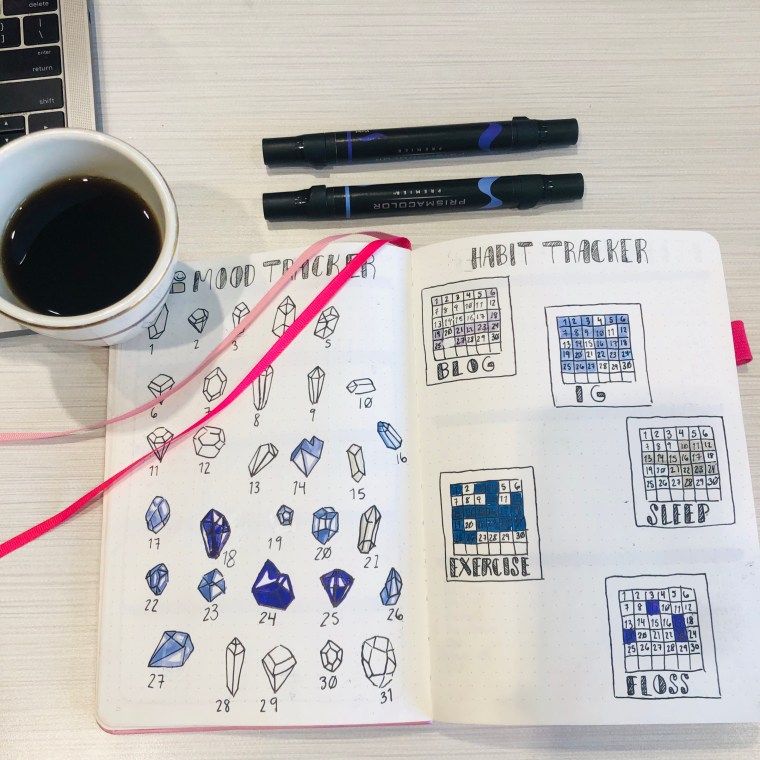
These bullet journal spreads just take so much time! I love doing them, but I need to sit down and devote a solid five or six hours to getting everything drawn. The reality is, they’re never really done until the month is well-over. And sometimes they’re never fully-done — you may notice that my mood tracker was never filled in for several days towards the end of the month, for example.

That’s what I love though. Because I can’t draw everything at once, I have to work on it a little bit at a time, especially with the mood tracker doodles. It’s not a daily thing, but it certainly is an every-several-days-or-maybe-once-a-week thing. It gives me a way to keep up with my drawing, even if it’s only drawing simple line illustrations.

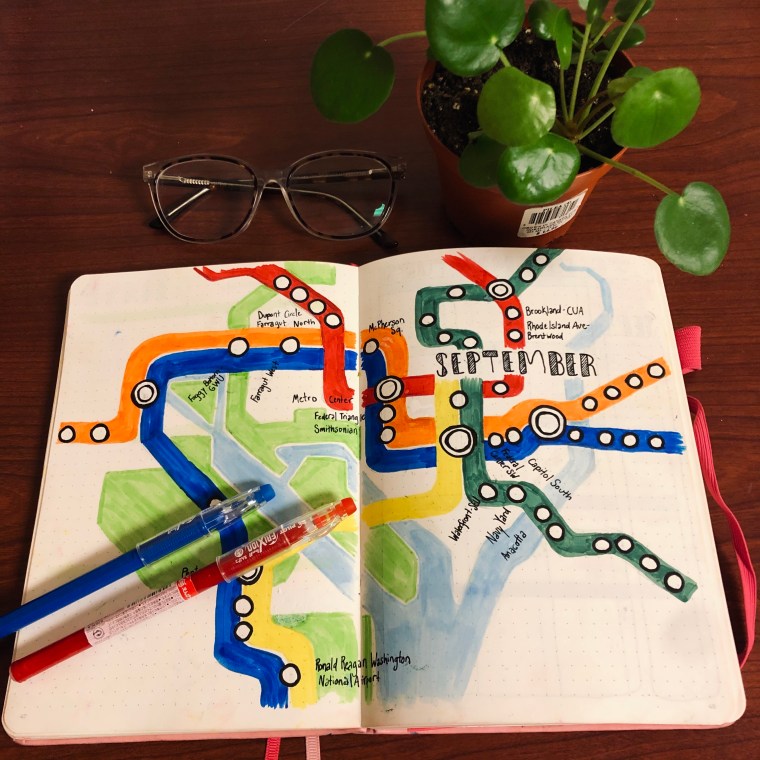
The only part that I really try to do all at once in one sitting is the month cover page (the part that says “September” with the big drawing of the Washington DC Metro map). The cover page sets the theme and color scheme for the rest of the pages, so I have to complete it first. Ideally, I’d have it done before the month actually begins.

Well, ideally, I would have posted this blog before the end of September, so you can tell where my ideals get me.

Regardless, I hope you enjoy looking at my bullet journal spread, even if the month it’s about has come and gone. I rather like how the Washington DC public transport theme played out, especially on the cover page. The color scheme isn’t as strong with this one (I tried to do like, a red-white-and-blue thing, but it was hard), and I ran out of Washington DC doodles for my mood tracker and I had to resort to random Americana imagery, but I’m still satisfied with the overall product.

Thanks for reading, and I’ll see you in the next one. Don’t forget to check me out on Pinterest, Instagram, Facebook, BloglovinTwitter, and Tumblr! For business inquiries, shoot me an email at lensembledujour@gmail.com!


Bullet Journal Supplies (with Amazon links)

Bullet journal: The Scribbles that Matter Pro, A5, 

Pens: Pilot Frixion 

Markers: Prismacolor Brush Tip  and Copic Brush Tip


March 28, 2019 – Welcome to the Sixties (OOTD #484)

Hey, remember when these blogs actually somewhat aligned with the real calendar date? Me neither.

So I’ve sort-of fallen behind. I hope you (and by you, I mean all three regular readers I suppose I have) don’t mind. I do actually really like to have a little bit of space in between the actual day the blog is supposed to be about and the date of that blog’s publication, but  three months is a little ridiculous; even I can admit that.

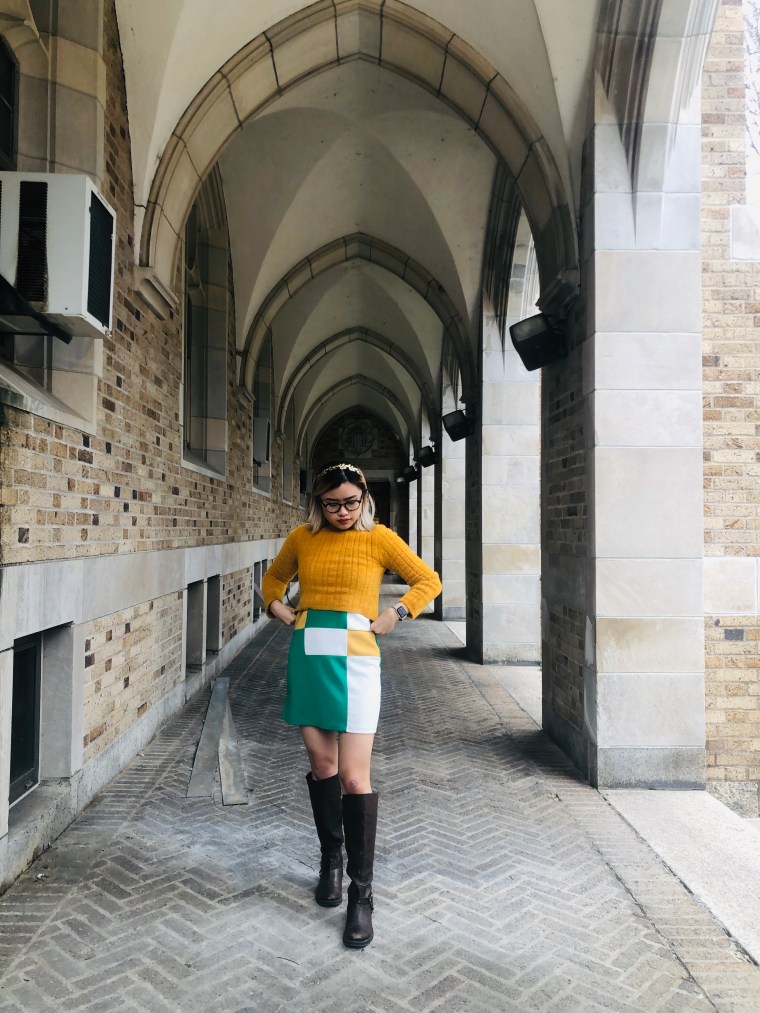
Regarding March 28’s outfit, though — it’s one of my favorites from March. I mean, I like the majority of my outfits — hence bothering to keep a fashion blog at all — but I’m particularly proud of this one.

Ever since I bought this retro disco dress at a vintage shop in Chicago, I’ve struggled to figure out how to wear it in new and interesting ways. It’s a great dress, don’t get me wrong — I love how blatantly 60s it is, it’s practically something I could have purchased at a Halloween shop with a Brigitte Bardot wig. However, that also poses problems — how do I wear it without looking like I purchased it at a Halloween shop?

It’s not exactly a dress I can throw a denim jacket over. It’s a deceptively simple dress; there’s very little to its design, but because of its bold pattern that immediately dates it to the 1960s, I have to be careful with how I accessorize it. Anything that seems more modern than the 60s, such as a denim jacket, would look silly when paired with it.

I thought this sweater was a good compromise. It’s got something of a vintage vibe to it as well, no?

I love this sweater — I honestly probably wear it way too much. For a cheap Forever21 purchase, it’s certainly lasted me a long time. It also happens to be my new favorite color to wear — yellow. Seems like a double-win for me.

That’s about it for today. Thanks for reading, and I’ll see you in the next one with more updates on my life at Notre Dame. Don’t forget to check me out on PinterestInstagramFacebookBloglovinTwitter, and Tumblr! For business inquiries, shoot me an email at lensembledujour@gmail.com


Dress: A vintage shop in Chicago

Sweater: Forever21


March 25, 2019 – Twirly (OOTD #481)

There’s no shortage of stained glass at Notre Dame — but there is a shortage of stained glass that’s in a place where I can take pictures of it.

For one, a lot of it is in high places, where I can’t reach to stand to take a picture with it. For another, it’s usually inside a church or chapel — and there seems to be something weird to me about taking a picture in a place of worship, even if it’s completely empty and I’m the only one there. I have used an ND chapel for pictures once before on this blog, but to be honest, I still don’t know how I feel about it.

I don’t, however, have any issue taking photos outside of churches or other places of worship — just check out this Buddhist temple in Nepal, this mosque in Qatar, or this church in England that have all been featured on my blog. The ND basilica has shown up here once or twice as well. The architecture of these places of worship is meant to be admired — and as long as I keep my fashion photography on the outside, where no table-flipping Jesus can get mad at me for turning a church into a marketplace, I feel okay with myself.

And so that’s where these photos come from — the outside of a chapel within one of Notre Dame’s buildings. It’s not the most stunning chapel on campus, nor is it the most stunning exterior architecture or stained glass, but you have to admit that it goes nicely with my outfit.

I even figured I’d give the dress a bit of a twirl, which I almost never do because of a) how difficult it can be to get a good shot and b) how ridiculous it looks to passers-by. I’m already stood outside of a chapel in a classroom building taking pictures of my outfit — I don’t need to look any sillier.

That’s about it for today. Thanks for reading, and I’ll see you in the next one with more updates on my life at Notre Dame. Don’t forget to check me out on PinterestInstagramFacebookBloglovinTwitter, and Tumblr! For business inquiries, shoot me an email at lensembledujour@gmail.com


Dress: Francesca’s

Bralette: Aerie

March 23, 2019 – Branding (OOTD #479)

I’ve discussed this before, but color can be rather hard to come by at Notre Dame.

Our buildings are pretty much all the same tan-gold brick — which is still very pretty and really gives the campus a sense of cohesion, however, it makes for rather dull backgrounds in fashion photography. Most of the year, the scenery is pretty colorless too — especially in the winter, when campus is covered in snow 65% of the time.

And naturally, the majority of classroom buildings are on the plain side as well. That’s not a huge complaint of mine — I don’t need a rainbow mural adorning every single wall — but when it comes to trying to find interesting and diverse backgrounds for my blog pictures, it can sometimes be a challenge. I’ve used everything from bathroom walls to stairwells to

And now, a new background enters the scene — this large colored poster from the student government office.

The student government office has turned into one of my favorite places to study on campus because I can usually guarantee that it’ll be empty. When there are no meetings in session, the space normally sits vacant — making it a great place to set up shop and get work done. There’s even free coffee from the Keurig.

There’s also this poster, which I’ve been eyeing for quite some time to use as a background for an OOTD post. My only hesitation has been just how student government-centric it is — my blog isn’t an advertising space for other organizations (unless they’re paying me, and even so, that’s usually reserved for Instagram posts), and I don’t really like to feature logos prominently unless it’s something specific to fashion.

But it was cute and colorful, and I thought — why not? I’m not against Notre Dame’s student government, and I am technically a part of it (albeit a very small one). It’s a small price to pay in order to get a colorful background in early spring at Notre Dame on my Instagram feed for once.

That’s about it for today. Thanks for reading, and I’ll see you in the next one with more updates on my life at Notre Dame. Don’t forget to check me out on PinterestInstagramFacebookBloglovinTwitter, and Tumblr! For business inquiries, shoot me an email at lensembledujour@gmail.com


Sweater: Vintage (thrifted)

Dress: Thrifted

March 21, 2019 – Empty Buildings (OOTD #477)

I’ve got a fascination with abandoned buildings.

As many people do — I’m not trying to claim that that’s a unique feature of mine. I love following urban exploration photographers on Instagram and subreddits like r/AbandonedPorn.

In reality, though, I’ve visited very few abandoned places in my life, mostly out of the concern for the legality of trespassing and the potential of meeting unfriendly junkies. I went to my old elementary school once with a friend, but that’s it. I’d like to actually visit some of these cool places I see online, but I also don’t want to die/get arrested, you know?

As it turns out, though, Notre Dame has (at least for now) an abandoned building of its own. Or rather, it’s not really very abandoned — it’s in a pretty central location on campus and it’ll likely be repurposed and functioning again by the start of the next academic year. I suppose empty is the better word.

It’s the old architecture building, which, since the beginning of the spring term 2019, has been out of commission. They recently opened up a brand new architecture building (which I literally visited for the first time just a few days prior), and so the old one has been sitting empty for a month or two. I think they’re in the process of moving some office buildings in, but at the time of me taking these pictures, it was pretty much vacant.

Honestly, I’d love to see it turned into a new building for the art and design students. I’ve discussed the dilapidated art building extensively here, and while I do believe the state of dilapidation adds to the charm, Notre Dame could really use to offer its studio art students a nicer space. The design building, West Lake Hall, is honestly worse. It’s way off at the edge of campus, and most people believe it’s a maintenance building for storing lawn mowers. Not really a good image for the design department.

You’d think that the old architecture building, which is already set up with studio spaces, would be an excellent place to move the A/AH/D (art, art history, and design) department, but I guess Notre Dame has other plans.

Anyway, Father Jenkins — or anyone in ND administration — if you happen to be reading this, you know what my ideas are.

That’s about it for today. Thanks for reading, and I’ll see you in the next one with more updates on my life at Notre Dame. Don’t forget to check me out on PinterestInstagramFacebookBloglovinTwitter, and Tumblr! For business inquiries, shoot me an email at lensembledujour@gmail.com!


Dress: Vintage (thrifted, Brick Lane Market)

Jacket: Thrifted (Goodwill)

Saturday Musings – March 2019 Bullet Journal Spread!

One of my favorite things about sharing my bullet journal spreads on this blog is that I don’t have to come up with a creative blog titles — I can just announce that I’m writing about my bullet journal spread and be done with it.

Anyway, this blog will be about my March spread. Please don’t pay attention to how this is being posted on March 30, also known as the second-to-last day of the month.

As I see it, though, people can still be inspired by my bullet journal drawings regardless of when in the month it is — it’s not like I’m a bullet journal influencer, so I don’t see any reason to post my spreads at any particular time. Besides, I’m new to bullet journaling myself, so I don’t see myself as anything worth copying at the moment. In fact, I’m still copying the layouts of some of my favorite artists, like AmandaRachLee.

I’m kind-of surprised with myself for managing to keep up with bullet journaling for so long (that is, if you ignore the three-month hiatus I took from October-December where I basically didn’t write/draw anything at all). I really like it as a way to force myself to draw a little every day — since I’m not in art classes really anymore, it’s a great way to try to exercise my skills.

I honestly wish I had more time to devote to it, though — I sometimes find that I end up rushing through a design/spread because I know I have limited time each day realistically to work on my journal. I wish I could do elaborate, time-intensive, and detailed drawings each month, but they usually end up pretty simplistic.

And simplistic isn’t a bad thing! But a lot of my artwork in the past was very detail-oriented, and there’s nothing really I’m doing right now to practice that kind of artwork. It’s looking like I’ll have a month at home in between my various travels, so maybe that’s something I’ll work on then.

Thanks for reading, and I’ll see you in the next one. Don’t forget to check me out on Pinterest, Instagram, Facebook, BloglovinTwitter, and Tumblr! For business inquiries, shoot me an email at lensembledujour@gmail.com!


Bullet Journal Supplies (with Amazon links)

Bullet journal: The Scribbles that Matter Pro, A5, 

Pens: Pilot Frixion 

Markers: Prismacolor Brush Tip  and Copic Brush Tip