August 25, 2019 – Rainbow Road (OOTD #554)

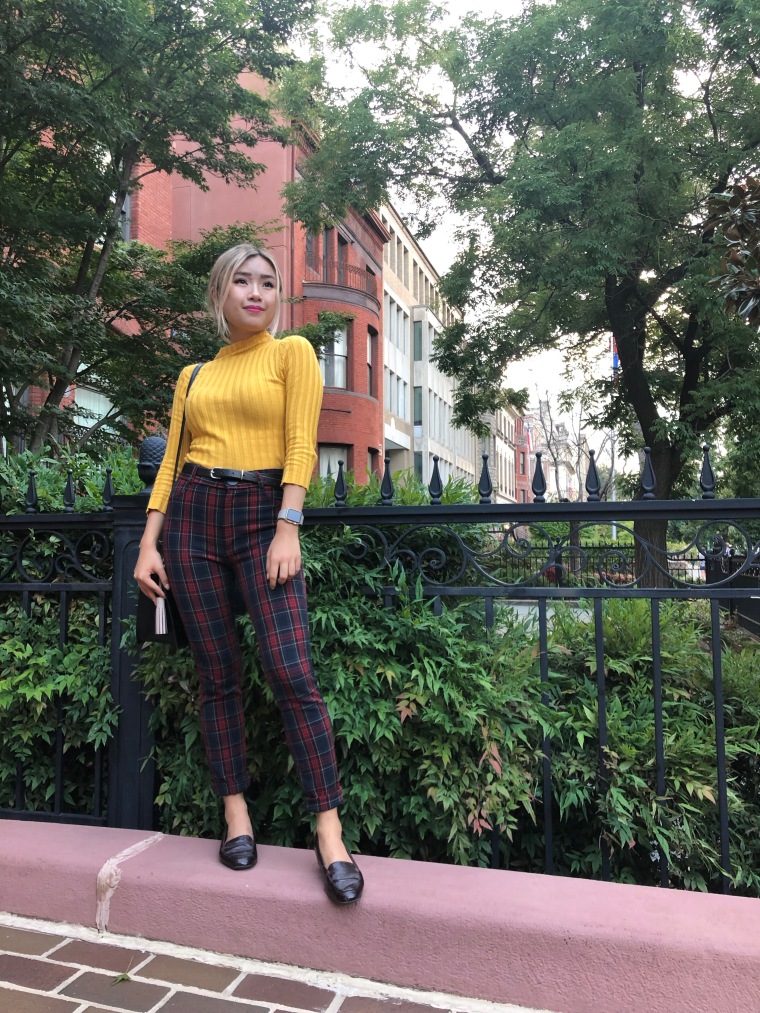
You know, if you squinted, this could almost pass for a part of Notting Hill in London.

Look, I’ll be up front about it: Washington DC is not my favorite city in the world. It’s not even my favorite city in the US. As much as I’m grateful to be here for the semester as a part of an internship program with Notre Dame and as much as I’m excited to be away from South Bend for a few months, my enthusiasm is more to do with what goes on in DC, rather than DC itself.

That’s about it for today. Thanks for reading, and I’ll see you in the next one with more updates on my life this semester in Washington, DC. Don’t forget to check me out on Pinterest, Instagram, Facebook, BloglovinTwitter, and Tumblr! For business inquiries, shoot me an email at lensembledujour@gmail.com!


Dress: Thrifted (the pile of abandoned clothing in my dorm room’s laundry room)

Jacket: Forever21

August 24, 2019 – The Washington Way (OOTD #553)

Finally, my actual location and the location that I’m writing about in my blogs match up again!

IMG_6539.jpeg

As I’ve mentioned before, the content I’m posting about in my blogs tends to be a bit behind (or, has been the case recently, quite behind) the date I’m actually posting it. For example, I’m writing this blog in late October, but it’s about something that happened back in late August. So in late August, I was moving in to my apartment in Washington, DC.

But wait, Washington DC isn’t in Northern Indiana! Isn’t there where I normally go to school? Why wasn’t I moving back into my dorm at Notre Dame in late August, along with all of my friends and the rest of the student body?

The answer: because I’m taking a semester away from Notre Dame to do a special program though the Political Science Department to take a full 15-credit semester course load while working an internship here part-time. Think of it like a study abroad semester — except of course, DC isn’t really abroad.

IMG_6574.jpeg

Unlike a semester abroad, however, I get to work (and in my case, get paid!) while maintaining my status as a full-time student. And at any rate, I get to go abroad in the spring semester anyway, so I really get the best of both worlds.

IMG_6541.jpeg

What I don’t get, however, is the third world: my friends back on campus at Notre Dame. I’m going to be away for a whole year, and that’s kind of saddening. Not saddening enough to prevent me from doing it (and honestly not even really saddening enough for me to give a second thought about whether I wanted to do it), but enough so to make looking at my friends’ Instagram posts of them moving back into the dorms a little bittersweet.

That’s about it for today. Thanks for reading, and I’ll see you in the next one with more updates on my life this semester in Washington, DC. Don’t forget to check me out on Pinterest, Instagram, Facebook, BloglovinTwitter, and Tumblr! For business inquiries, shoot me an email at lensembledujour@gmail.com!


Turtleneck: Forever21

Trousers: Zara


August 16, 2019 – End Times (OOTD #549)

I’m really on a roll with these religion-themed blog titles.

IMG_6026.jpeg

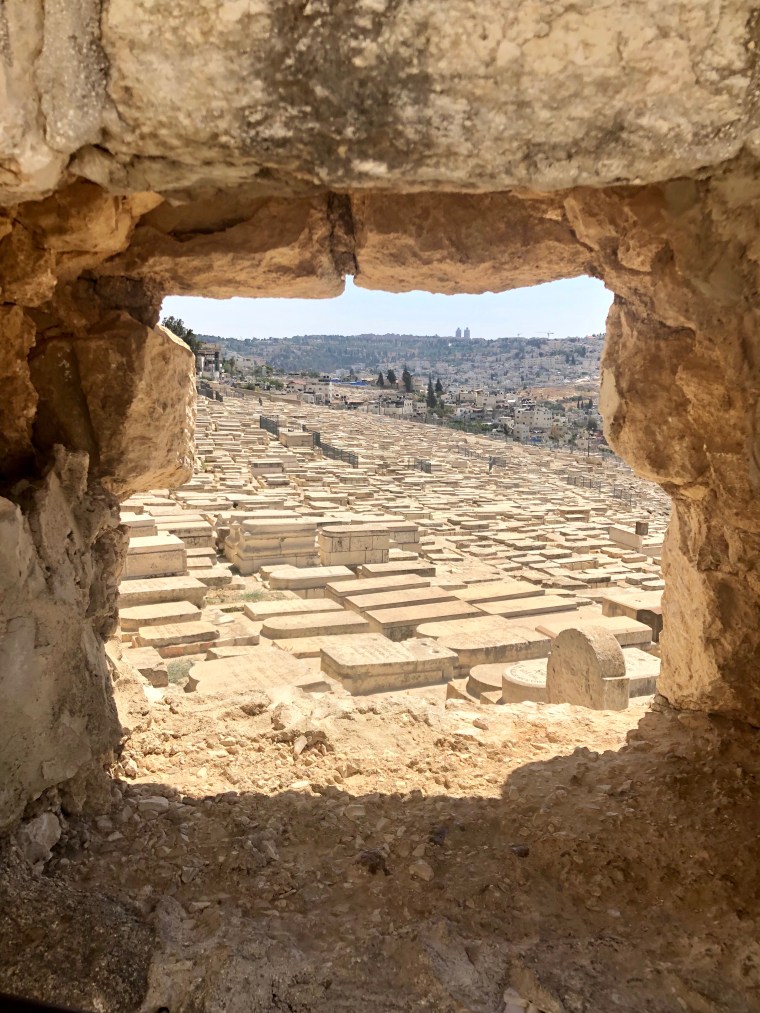
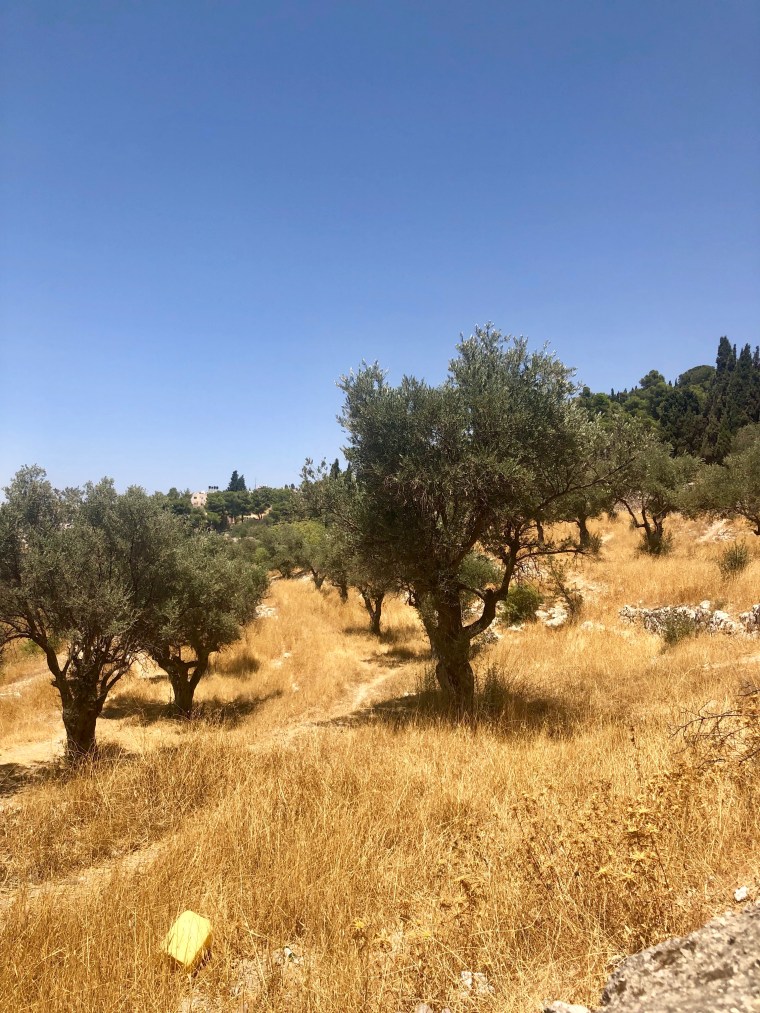
The reasoning behind this one, if it weren’t clear (which, to be fair, it’s probably not on the surface) is because this was my last day in Israel-Palestine, and I visited the Mount of Olives — the location where some faith traditions believe the end of the world will occur.

IMG_6150.jpeg

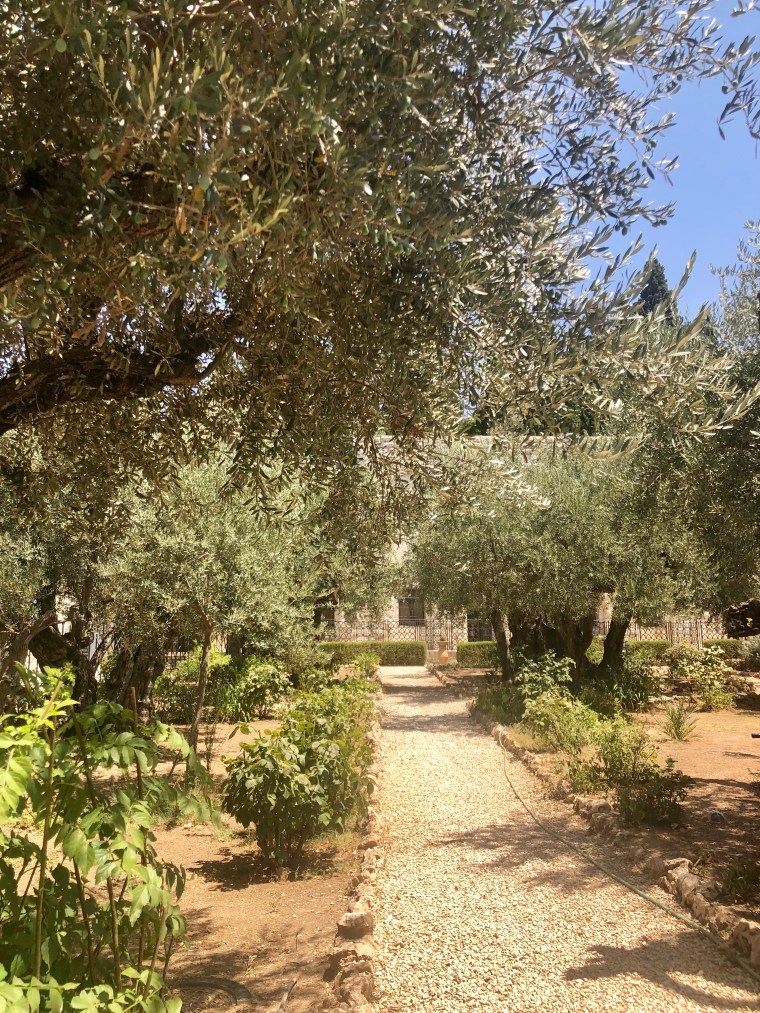
Another layer of meaning you could derive, if you so choose to, is that I also visited the Garden of Gethsemane, the place where Jesus stopped and prayed before the end of his life. It was also a Friday, the end of the working week and the beginning of the Jewish Sabbath, Shabbat. 

After my big tour the previous day, I felt like I had pretty much seen everything within Old City that I wanted to see, so I decided to walk a little beyond the bounds of Jerusalem city center. After consulting the Internet for ideas of things to do in Jerusalem for free on Shabbat, I decided on the Garden of Gethsemane and the Mount of Olives.

IMG_6012.jpeg

And I wasn’t disappointed. I don’t know if I’d say either of them were my favorite sites from the whole trip (to be honest, I don’t know if I could choose just one) but they were a perfect way to get away from the insanity that is Jerusalem. Jerusalem wasn’t Rome insane, but, like Rome, it’s an ancient city that modern people live in — as a result, the limitations of architecture that was only built to accommodate donkeys and foot traffic is  constantly coming into conflict with the demands of 21st century life. I can’t tell you how many times I was almost run over by a scooter trying to drive through the narrow, winding streets of Old City.

IMG_5986.jpeg

Gethsemane wasn’t much to look at as a garden — sure, it was lovely, but it’s no grand botanical conservatory, like what Copenhagen has. It’s simple and small — you can walk the perimeter in about two minutes. There’s an attached church, as with all of the “holy” Christian sites in Jerusalem, but it’s no architectural marvel.

What makes the Garden of Gethsemane great is that it’s one of the only sites in Jerusalem that actually looks somewhat like what it might have looked like in Biblical times. You can visit the Church of the Nativity in Bethlehem, but there will be no traces of the stable that supposedly used to stand there. You can visit the Church of the Holy Sepulcher in Old City, but there’s no geographic indication that is was once a hill where the crosses stood. In fact, as I understand, many historians question whether these are the real locations of these famous religious events at all — or whether they’re just based on tradition stemming from an era of Crusaders who were desperate to claim they’d discovered the location of Jesus’s first carpentry classes.

The Garden of Gethsemane, however, actually is the garden from the stories. And furthermore, the olive trees may even potentially be the trees (or at least, descendants of the trees) that were there in Biblical times. Though the trees are too old to date precisely, scientists have determined that it’s possible that several are at least 900 years old, possibly older.Compare this to the (in my opinion) somewhat gaudy Church of the Holy Sepulcher, where Jesus was supposedly crucified, that’s surrounded on all sides by apartments and shops that prevent you from visualizing Golgotha as it might have looked 2000 years ago, and you see why I liked Gethsemane so much. A local caretaker for the garden even offered me some clippings from the olive trees and some saffron (which he instructed me to make tea out of in order to attract a boyfriend). IMG_6011

The other site I liked was the Mount of Olives. I wish it weren’t so hot when I made the climb from Lions’ Gate to the Church of the Ascension  (which I didn’t even go into because there was an entrance fee), but it made for a beautiful panoramic view of the city from the top. It made for the perfect end times to my Jerusalem trip.

IMG_6056.jpeg

That’s about it for today. Thanks for reading, and I’ll see you in the next one with more updates on my trip to Israel-Palestine this summer. Don’t forget to check me out on Pinterest, Instagram, Facebook, BloglovinTwitter, and Tumblr! For business inquiries, shoot me an email at lensembledujour@gmail.com!


T-shirt: Forever21

Turtleneck: Amazon

Jeans: Hollister

August 13, 2019 – Interlude (OOTD #546)

Here’s the thing about independent research trips: you don’t have to do research for the whole time.


Or maybe you do — I don’t know, I’ve never done one before. Maybe a good researcher would spend all of their time devoted to their work. Alternatively, maybe all research trips are fake and people just go on them to travel to exotic places on their university’s budget. What do I know?

IMG_5407.jpeg

Anyway, after a whole day devoted to working on my research project on the West Bank border graffiti, I decided I deserved a break. I knew I needed to go back to the border and have a closer look at some of the graffiti, but it’s not exactly an easy task. I needed another day or two to research how even I could get back to the area safely on my own, so in the meantime, I decided to do something a little more accessible to the average tourist.

What I ultimately decided to do was visit Yad Vashem, the World Holocaust Museum.

IMG_5427.jpeg

What I show here are not photos of me at Yad Vashem for what I think should be an obvious reason — a memorial to genocide is not the place for fashion photography. Sure, I took pictures while I was there of the exhibits, but the focus was on the exhibit, not me. As much as I like to make things about me, the Holocaust is far beyond the scope of even my narcissism.IMG_5418.jpeg

I did like my outfit though, so instead, I got some pictures with a sculpture and a nice hill overlooking the city in a nearby park.

It was a great museum though, seriously. That’s coming from me — a person who normally finds museums (except for art museums) to be dull and slow. The best part — as is the best part with a lot of museums to tragic events, such as the 9/11 Museum — were the video testimonies from people who lived through it. Diary entries and photographs and personal belongings help embellish the narrative, of course, but only the people who lived the experience can tell the story.IMG_5372.jpeg

They also did a fair job, in my opinion, from keeping the museum historical, rather than making it into it about why Zionism and a national Jewish state need to exist (though they did touch on that in the last room or two). Having just come from Palestine the previous day, I appreciated the dominantly historical approach.

That’s about it for today. Thanks for reading, and I’ll see you in the next one with more updates on my trip to Israel-Palestine this summer. Don’t forget to check me out on Pinterest, Instagram, Facebook, BloglovinTwitter, and Tumblr! For business inquiries, shoot me an email at lensembledujour@gmail.com!


Coat: Forever21

Dress: Vintage (thrift, Brick Lane Market)

Blouse: ASOS


August 12, 2019 – The Writing on the Wall (OOTD #545)

Here we are: the actual reason for my trip to Israel-Palestine!

I didn’t really discuss this in my blogs from last spring, but I spent a sizable chunk of time before spring break writing a grant proposal to go to Jerusalem to do some research. It was a long shot — I never thought I’d actually get the money to go, and I mostly considered it an experiment with the grant-writing process (which I had only done once before, to go to Vichy for a week-long language intensive in French) that would be useful practice for later.

The plan to go to Israel-Palestine stemmed from the time I’ve spent over the last two years working with the Madrasa Discourses project, for the conciliation of traditional Islamic thought with modernity in India and Pakistan. The idea first came from a friend that I made while in Doha with an MD conference. She was the one who originally proposed turning our experiences with Madrasa Discourses and interreligious dialogue into an independent project, and so I owe it to her for inspiring me to actually go through with the whole undertaking.IMG_5062.jpeg

Though she ultimately couldn’t go, which was a huge factor in determining my level of comfort going to a politically tense area like Jerusalem, I still decided to do it. You don’t get a grant from your university to do research every day — especially when the research takes you to a country and a culture you’ve experienced been before.

There have been many famous walls throughout history – the Great Wall of China, the Berlin Wall, the of Northern Ireland Peace Lines – and now a new barrier wall has joined their ranks.

This barrier wall is the West Bank barrier, which separates the Muslim-dominant Palestine from the Jewish-dominant Israel. Described by Israelis as a “security fence” (geder-ha-hafrada) and by Palestinians as an “apartheid wall” (jidar al-fasl al-‘unsuri), the barrier has been a subject of controversy ever since its construction began in 2002. Out of controversy and political unrest, however, can spring one of the most passionate and creative forms of self-expression: art.

IMG_5070.jpeg

Much like what was seen in Berlin and Belfast, artists in Jerusalem have transformed the concrete that separates Israel and Palestine into a canvas for political discussion. On either side of these walls, activists, professional artists, and civilians have used graffiti as a way to express opinions about the situation in Israel-Palestine and the barrier’s existence.

During the course of my one-week journey to Israel-Palestine, I studied this political graffiti on the West Bank border wall, focusing specifically on the area around Bethlehem. My goal was to discover some of the artistic themes on the wall and how those reflected local sentiment about the ongoing Israel- Palestine conflict. More specifically, I wanted to study how the opposing narratives of the border wall as a “security fence,” as it is referred to by many Israelis, or as an “apartheid wall,” as it is referred to by many Palestinians, were evident in the wall’s artwork.

If you’re not familiar with the situation in Israel-Palestine surrounding the border wall, here’s a little context: the border was initially constructed by Israel to protect against extremist Palestinian bombings, and to many Israelis, it has done its job well. In 2004, approval of the wall for Jewish-Israelis was at 78%, with many arguing that it had caused the shift from nearly-weekly bombings in 2003 to only three attacks in 2004. IMG_5087.jpeg

However, though the barrier primarily follows the Green Line (a 1948 armistice border acknowledged by the UN), it swerves east several kilometers to incorporate certain Israeli settlements. To many Palestinians, this is nothing short of occupation and land grab. The wall cuts off many Palestinian citrus and olive farmers from their land, making it difficult or impossible for them to harvest their crops because of the new security checkpoints. Crossing the checkpoints from Palestine-controlled Bethlehem to get into Israel-controlled Jerusalem also poses many problems for Palestinians; people begin queuing hours in advance on weekday mornings so that they can get to their jobs in Jerusalem. Many simply bypass the checkpoints and cross the border illegally every morning instead — something Israeli employers easily take advantage of by refusing to pay “illegal” Palestinians for labor they have already completed.

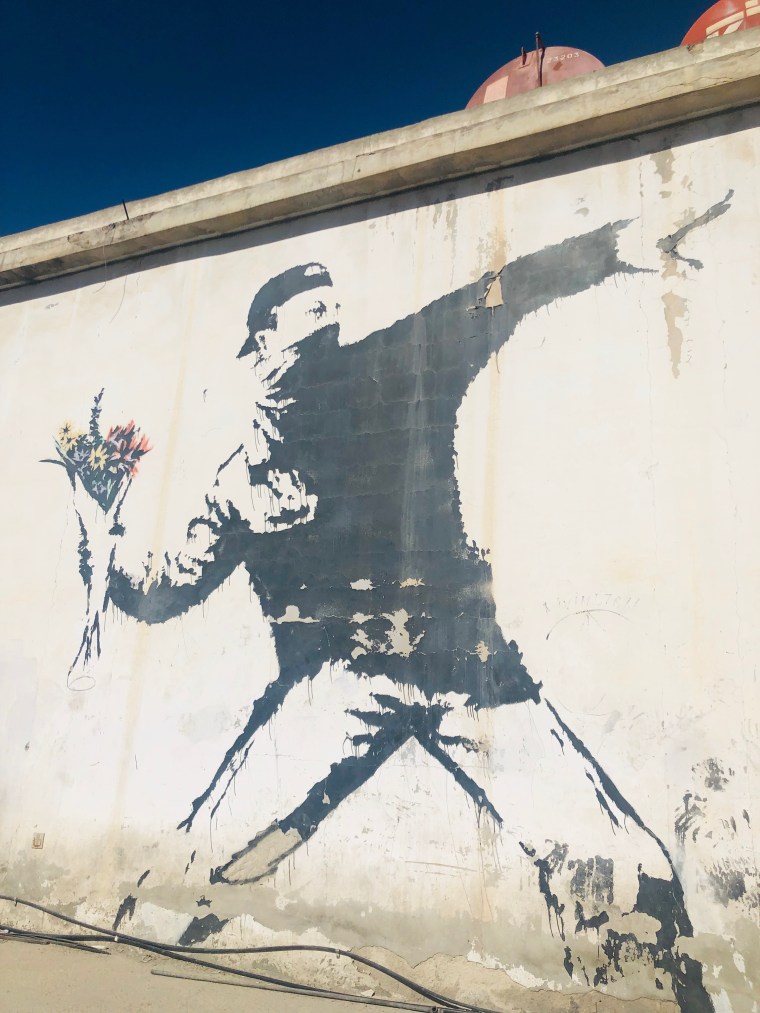
With this background in mind, I began my preliminary research by taking a graffiti tour with a Palestinian guide. This initial tour was crucial, as he was able to point out key pieces of art (such as those by famous English graffiti artist Banksy) and direct me to other wall-related graffiti that was in the area but not necessarily on the wall itself. I came back at a later date to actually scrutinize individual pieces and photograph the wall itself; this first day was just to get my bearings with the help of a local. With this as my main goal for the day, I was able to relax a little and just enjoy learning.

IMG_5134.jpeg

Due to the constantly changing nature of graffiti, some of the pieces that I had seen online when I had been doing research for my grant proposal had been completely removed or covered by new pieces of graffiti. For example, one, which had previously depicted President Trump and Prime Minister Netanyahu in a kiss, had been altered to remove their embrace. It may be interesting to go again in a year or so to see how the visible graffiti has changed — which pieces have been scrubbed away, or covered up by other graffiti, or had their message altered.

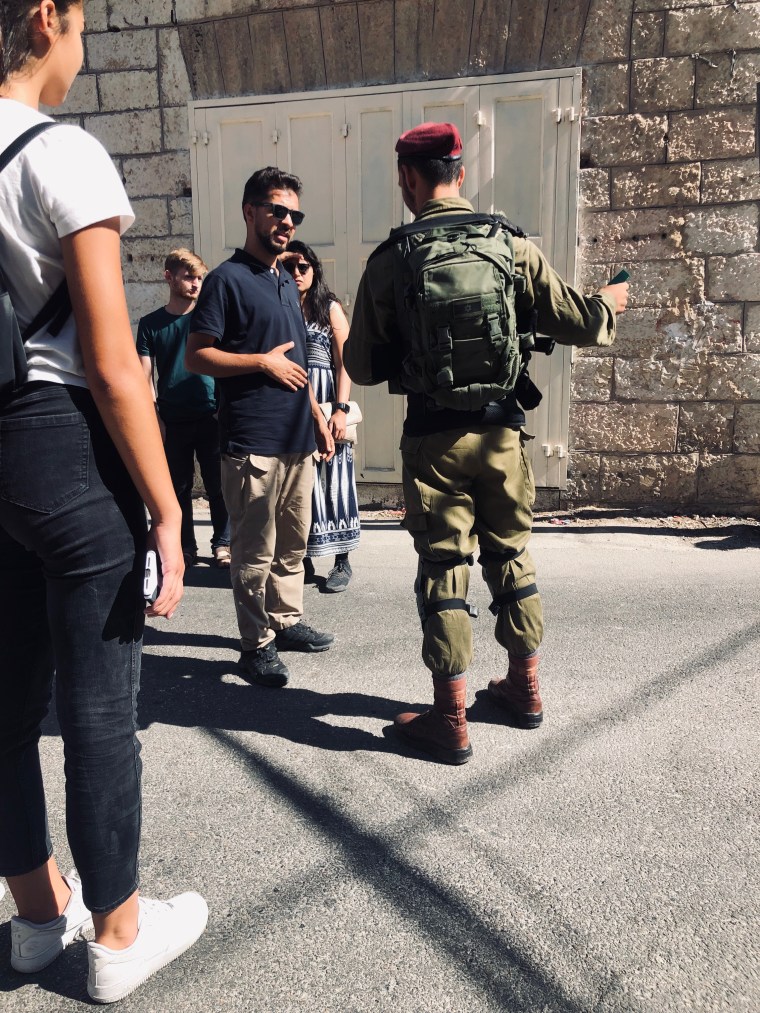
My guide also took me into Bethlehem to see a Palestinian refugee camp, where I got to talk to some locals (including an elderly man who rememberd when the Palestinians were orignally evicted from their homes in 1948 during what is known to Israelis as their War of Independence and known to Palestinians as The Nakba, meaning “the Catastrophe” in Arabic). Seeing the lives of Palestinians as they went about their days was honestly just as impactful as the graffiti. At one point, we had to cross into a piece of territory that was technically under the control of Israel. We, as foreigners, were allowed in but our Palestinian guide was stopped by IDF soldiers before he even got to the checkpoint.

IMG_5230.jpeg

But it wasn’t all politics and gloom — we visited a part of Hebron, where we saw a glassblowing workshop. We also saw the Church of the Nativity in Bethlehem, the (honestly, kind of tacky) Crusade-era church built to commemorate the supposed birthplace of Jesus. And we got lunch at a really lovely Palestinian cafe, which was still open despite the fact that it was a Muslim holiday and most places were closed.

IMG_5210.jpeg

When I originally wrote this grant proposal, I had hoped to learn about both sides of the Israel-Palestine conflict through the artwork on the wall. As it turned out, there wasn’t much artwork on the Israeli side at all, nor was there much artwork on the Palestinian side that might be described as “pro-Israel.” I thought that this might be the case going in — graffiti often being used more as a vessel for protest rather than praise — so my trip helped to confirm my belief.

Because I actually visited Palestine/the West Bank, rather than just viewing images of the wall online, I actually got a sense of what life is like for the Palestinians who live behind the wall. Perhaps most apparent was the great wealth disparity that was immediately visible as soon as I crossed from Jerusalem to Bethlehem. They feel like worlds apart — one is relatively safe, modern, and comfortable, and the other looks more like what you’d imagine a war zone in the Middle East to be. The massive concrete wall, guard towers, and IDF soldiers watching you from above doesn’t help.  

IMG_5132.jpeg  

Do I recommend that you go to the wall itself? Personally, I feel a little conflicted about the concept of political tourism, because actual people’s lives aren’t something to be gawked at and photographed like animals at a zoo — however, it’s critical to educate yourself about the history and political context of the places you go, and one of the best ways to do that is simply to pay a visit to a contested area. Each city has one– it’s Freedom Square in Budapest, it’s the Opéra in Vichy.

As the quote goes, travel is fatal to prejudice, bigotry, and narrow-mindedness. Respect the people you encounter, don’t treat it like it’s another tourist destination for Instagram, and share what you see if it so moves you to consider a different perspective or narrative than you thought you knew.

If you ever get the chance to visit Israel-Palestine, I highly recommend popping over to the West Bank to get the Palestinian story. Whatever you decide, do as the writing on the wall says, and “don’t be a brick in this wall.”IMG_5145


That’s about it for today. Thanks for reading, and I’ll see you in the next one with more updates on my trip to Israel-Palestine this summer. Don’t forget to check me out on Pinterest, Instagram, Facebook, BloglovinTwitter, and Tumblr! For business inquiries, shoot me an email at lensembledujour@gmail.com!


Top: Zara

Coat: Forever21

Trousers: Altar’d State

August 11, 2019 – The Promised Land (OOTD #544)

Here we are, the very last of my summer break 2019 travels!

I think the Galàpagos to Jerusalem flight sequence was one of the longest I’ve ever experienced. It went a little something like this:

  • Take a panga boat from the cruise ship in the Galàpagos to the shore, early morning August 9
    • Take a ferry to another part of the island
    • Take a bus to the tortoise reserve
    • Take a bus to the airport
    • Fly from the Galàpagos back to coastal city in mainland Ecuador, midday
    • Fly from the coastal city to Quito, afternoon
    • Fly from Quito to Atlanta, late night
  • Arrive in Atlanta, early morning August 10
    • Fly from Atlanta to New York JFK, morning
    • Fly from New York JFK to Tel-Aviv, late afternoon
  • Arrive in Tel-Aviv, early morning August 11
    • Take a shared cab from Tel-Aviv Airport to hostel in Jerusalem
    • Arrive at hostel in Jerusalem, late morning

By the time I made it to my hostel in Jerusalem, I was exhausted — but not super sleepy. I was tired from all of the traveling, from moving from boats to buses to ferries to airplanes to taxi cabs over the course of 48 hours, but I had actually managed to get a decent amount of sleep during the commute. It maybe wasn’t a great quality of sleep, but at least it was sleep.

Arriving on Israel on my own was rather scary. I mean, I’ve done it before — arriving in airports in new cities in new countries and having to make my way into the city — but Tel-Aviv was different. I’ve traveled on my own in Europe, but not before in the Middle East.

The remarkable thing about traveling and being nervous about doing new things is that, assuming you actually do the thing, your nervousness doesn’t matter much. Being afraid to try something new affects whether you’ll actually do the thing (say, try to find a sherut shared taxi from Tel-Aviv to Jerusalem), but it doesn’t affect what happens after you’ve decided to do it. I was nervous to approach the cabbie and ask if he was going to Jerusalem, but that didn’t change whether or not I was going to have to do it or not. I had to make it from Tel-Aviv to Jerusalem, and that was that.

And I did make it. The cabbie wasn’t exactly a friendly guy, but thankfully, we didn’t have to talk long. A 45 minute drive later, he dropped me at my hostel, and I was on my way.

I was actually a little too early to check in to my room, and so I decided to go for a walk around the city to pass the time. The hostel had a place to store my bags, which was nice, and the concierge was able to point me in the direction of a free tour I could take later in the afternoon.
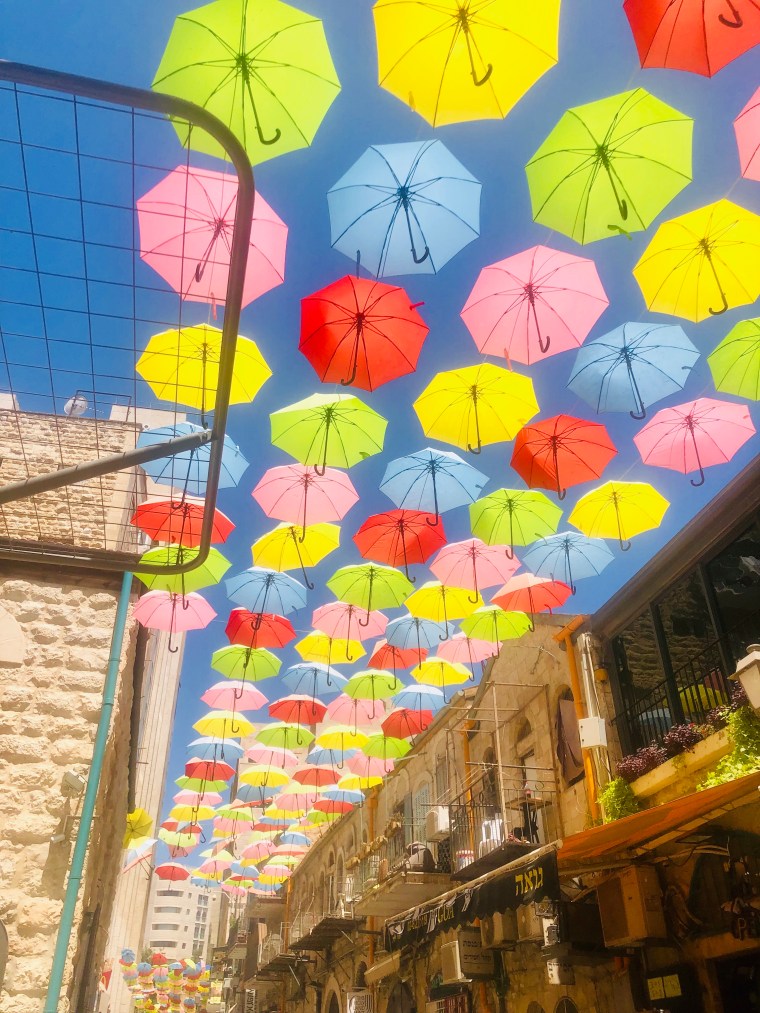
Before the tour began, I wandered around the area a little to see what there was. I had arrived during a holiday, which made it so that most of the shops and restaurants were closed. As it turned out, though, I didn’t mind — that also meant the streets were emptier, which made taking pictures like this, on a shopping street that might have normally been  busy, possible.

My free walking tour covered the four quarters of Old City Jerusalem — the Jewish Quarter, the Muslim Quarter, the Armenian Quarter, and the Christian Quarter. Since it was free, we didn’t actually go into any of the sites, like the Dome of the Rock or the Western Wall, but that was okay. I ended up seeing those later. Our guide took us to see a beautiful view of the city from a rooftop and to the Church of the Holy Sepulcher (honestly, one of the least exciting “holy sites” I visited — and that’s the one that was supposed to be most important to my religion). For free, it was everything I needed.

The one thing I was hoping to do on my tour that I didn’t was make friends. I was supposed to go on this research trip with someone else from school, but she didn’t end up getting the grant to go. I wasn’t looking for like, a best buddy, but I was hoping to talk to some people and maybe get to know someone from my hostel whom I could travel a little with. But to no avail.

That’s about it for today. Thanks for reading, and I’ll see you in the next one with more updates on my trip to Israel-Palestine this summer. Don’t forget to check me out on Pinterest, Instagram, Facebook, BloglovinTwitter, and Tumblr! For business inquiries, shoot me an email at lensembledujour@gmail.com!


Top: Forever21

Jeans: Hollister

Sweat: The Middle Eastern sun

August 8, 2019 – Birb (OOTD #542)

On August 8, I saw a lot of birds.

img_4616-2

For a while there, birds were my favorite animals (but cats are more my taste now). There was no particular type of bird that was my favorite during my bird phase — just whatever had wings and could fly (sorry ostriches and penguins). I’m 100% a girl who would have gotten a tattoo of birds in flight on my collarbone back in 2013 or whenever that was trendy. Bonus points if it comes with an inspirational quote about wanderlust.

I’ve never had a flying dream in my life, though I’ve always wished I could have them. Flight as a concept is just so cool to me — like, you just flap your wings and away you go. Maybe that’s why I like traveling in airplanes so much.

The main feature of both islands I saw were the birds. There were some sea lions and cool rock formations too, but the birds were really the main attraction. They were literally everywhere — in trees, on the ground, in the air, in the water. I guess that shouldn’t shock me — of course birds are populous on a pair of uninhabited islands. There are no humans to bother them and few predators to hunt them.

Because of this, they’re not nearly as skittish as most birds and will let you walk right up to their nest if you don’t make any loud noises. I got more cool bird photos on this day than I think I’ve ever gotten in my life.

The babies were all so big and fluffy! I wouldn’t have been surprised if you’d told me that they were full-size, and the blue-footed booby babies just looked like giant cotton balls for their entire lives. They’re the sort of animal that you just want to reach out and pet — you can’t, obviously, or else you’d ruin the whole point of not disturbing them so that they don’t become skittish in the future. Still, they were so cute. I’m having a hard time deciding whether the bird babies or the sea lions were the cutest creatures I saw on my trip — and yes, that includes the giant tortoises, which I’ll write about in an upcoming post.

That’s about it for today. Thanks for reading, and I’ll see you in the next one with more updates on my trip to the Galápagos Islands this summer. Don’t forget to check me out on Pinterest, Instagram, Facebook, BloglovinTwitter, and Tumblr! For business inquiries, shoot me an email at lensembledujour@gmail.com!


Outfit 1:

Top: Zara

Coat: Forever21

Jeans: Hollister

Outfit 2:

Dress: Forever21

August 4, 2019 – Quitting for Quito (OOTD #538)

Oops, I guess I couldn’t stay in the US for too long.

That’s right, two weeks after I returned home from Italy/Denmark/Hungary/Croatia/England, I was back off again — this time, to an entirely different continent that I had never been to before.

In addition to being my first time in Quito and in Ecuador, this was also my first time in South America altogether. You’d think being the closest continent to my own (North America), I would have been there before, but it’s not a super common destination for American tourists. Maybe that’ll change in the future?

View this post on Instagram

when the church is better styled than you

A post shared by Meilin || L'ensemble du jour (@lensembledujour) on

So why was I in Quito? It’s kind of a long story. The short answer: I won an essay contest.

The long answer: one day, I received a mysterious email from Notre Dame International inviting me (and the rest of the undergraduate student body) to apply for what could perhaps best be described as an “academic pilgrimage” to the Galápagos Islands be led by two professors from the Chemistry Department in the College of Science. The goal of the trip was described  broadly as to “trace the steps that Charles Darwin took on his path to discovery,” and in the process, perhaps gain a deeper appreciation for how discovery — in any field of study — occurs. That’s how I interpreted it in my application essay, at least.

I never thought I’d get in — I’m studying history and international relations, and I haven’t studied evolutionary biology since high school. I technically took some science classes my freshman year at Notre Dame, but they weren’t really that rigorous. I’m not even studying the history of science. I definitely haven’t studied anything chemistry-related that I could’ve used to impress the Chemistry professors leading the trip.

I guess my essay comparing the studies of human history and natural history impressed them though, because somehow, I got in. Or maybe it wasn’t the essay — maybe it was the outfit I wore to the interview. It was rather cute. You can actually check out the blog post from the day that I interviewed for the spot here.

Before heading to the Galápagos, our cohort of six stopped for a day in Quito, Ecuador.

Now, I’m used to traveling to new cities at this point. I’m used to trying to figure out public transportation, I’m used to trying to communicate with people whose language I don’t speak, I’m used to trying to keep my head down and doing my best to not look like a total outsider. I am not used to having a personal tour guide take me around a city and act as my translator and chauffeur all day.

For about 2/3 of our day, we had a very friendly man (whose name I’ve forgotten by this point — whoops) do all of that for us. He drove us around from site to site. He dealt with our tickets. He ordered our food. He acted as our historical guide at each place we visited. He showed us the best shops and best views of the city. Everything I’m accustomed to when traveling — the wandering around aimlessly with my eyes glued to Google Maps, the putting my headphones in to try to look more like a local, the avoiding eye contact in public places (especially in Europe) — I didn’t have to do any of it. Everything was taken care of.

It was so strange and so different. In one sense, it made the trip totally stress-free — the only thing I had to think about was making sure I didn’t lose our guide in a crowd. In another sense, it felt a little like something was missing. Sure, seeing the equator and a big old Catholic church and eating Ecuadorian food was cool — but it would have been cooler had I figured it all out on my own. It felt a little like cheating.

I certainly hope you don’t hear that as a complaint. Because uh…if anyone wants to give me another all-expenses paid vacation cruise with a personal tour guide, I’ll totally take it.

That’s about it for today. Thanks for reading, and I’ll see you in the next one with more updates on my trip to the Galápagos Islands this summer. Don’t forget to check me out on Pinterest, Instagram, Facebook, BloglovinTwitter, and Tumblr! For business inquiries, shoot me an email at lensembledujour@gmail.com!


Dress: Forever21

July 18, 2019 – Return to Sender (OOTD #534)

Spongebob narrator voice: Two months later…

Not to be all “going abroad changed me,”  but it definitely made coming home again weird. For one, everything is so far apart here, and there’s no way to get from one place to another without driving a perusal vehicle. What’s up with that?

Yada yada, save the planet, yada yada, need more public transportation options. We’ve been over this.

You’d think that after being away from home for so long, I’d want to stay home for a little while and recuperate from traveling, but I guess not. Just a few days after flying home from London, I was off again — though this time, to a much less exotic locale.

That’s right, I was heading back to South Bend, Indiana!

Why go to South Bend in the middle of summer vacation? Because my friend, Amanda, and I had gotten tickets for a preseason friendly to be played at the Notre Dame Stadium. Ironically, the team we were going to see — Liverpool FC — comes from the country I had just left. What can I say? I’m just such a big fan that I felt the need to follow them all the way back from Europe to the cornfield wasteland of the Midwest.

I’m actually not a huge football (meaning European football, this context) fan, and I don’t know much about the sport. I was mainly only going because Amanda wanted to. Had I known the date of the game would fall just days after my return to the US, I might not have so eagerly agreed to get back to South Bend.

These photos were actually taken in Louisville, the city where I met Amanda in order to make the drive up to together. I had to get my parents (thanks, Mom and Dad!) to drive me because I don’t have a car. If only there were a public transportation option, like a train, that ran from Lexington to Louisville…if only I were in Europe again where these systems and structures have been a part of society for decades and driving isn’t such a norm…

That’s about it for today. Thanks for reading, and I’ll see you in the next one with more updates on my life back home this summer. Don’t forget to check me out on Pinterest, Instagram, Facebook, BloglovinTwitter, and Tumblr! For business inquiries, shoot me an email at lensembledujour@gmail.com!


Top: (thrifted)

Jacket: Forever21

July 6, 2019 – Bizarre Bazaar (OOTD #527)

I can’t believe I didn’t use that as one of my Instagram captions.

View this post on Instagram

young trash that likes looking at old trash

A post shared by Meilin || L'ensemble du jour (@lensembledujour) on

As promised from yesterday’s blog about Budapest Central Market, I’m here now to discuss the superior of the two major markets in Budapest: the Ecseri Bazaar.

Being fair, they are two very different markets; it almost doesn’t make sense to compare them. Central Market focuses on food and *some* gifts and trinkets for tourists, while Ecseri is essentially a flea market. Central Market sells things that are brand new, while Ecseri sells things that are secondhand and vintage. Given my track record of buying vintage clothing, guess which one I was drawn to more?

View this post on Instagram

hey macklemore, can we go thrift shopping?

A post shared by Meilin || L'ensemble du jour (@lensembledujour) on

I went with my friend, Bilal, and I think he was bored out of his mind. Too bad for him, because I thoroughly enjoyed it. I absolutely adore looking at people’s old junk — especially people’s old junk in different countries and cultures. You can learn a lot about the history of a place by visiting a flea market, and Budapest was no exception.

I was tempted by a few pins that featured the classic Soviet hammer and sickle insignia, but there was no way to tell if they were authentic vintage pieces or just made in China reproductions for tourists like me. In the end, I wound up with two blouses and a coat — all for under 20 USD.

View this post on Instagram

yes homo

A post shared by Meilin || L'ensemble du jour (@lensembledujour) on

In the afternoon,  I attended the Budapest Pride Parade alongside my friend and his Central European University friends. Of the various protests/parades/marches I’ve participated in in the last three years, this one may have been the most significant. Here’s the thing: marches are often boring. You walk super slowly, you maybe say a few chants, and you look at the funny signs. Maybe you get a cute picture for Instagram,. You don’t go because you want to have fun; you go because you care about the issue, or at the very least, civil society’s right to protest about their issue.

View this post on Instagram

dude, that’s gay

A post shared by Meilin Scanish (@meilin_scanish) on

This is an overgeneralization, but for the other marches I’ve attended, the marchers wanted an expansion on something that already existed. For example, at the climate change strike in Rome, the students wanted the Italian government to do more than what they were doing to stop the climate crisis. For this march, the marchers wanted something that doesn’t really exist at all in Hungary — LGBTQ rights.

That’s a significant difference, at least for me as a participant. In the latter case — advocating to have something that doesn’t exist — you feel more like a catalyst, like a trailblazer. It’s riskier to say you want something new than to say you want more of something you already have some of. Both are perfectly valid forms of demonstration, but one, to me as an individual, is more personally engaging.

That’s about it for today. Thanks for reading, and I’ll see you in the next one with more updates on my life in Europe this summer. Don’t forget to check me out on Pinterest, Instagram, Facebook, BloglovinTwitter, and Tumblr! For business inquiries, shoot me an email at lensembledujour@gmail.com!


Outfit 1:

Top: Forever21

Trousers: Thrifted (Salvation Army)

Outfit 2:

Top: Vintage (thrifted, Ecseri Bazaar)

Shorts: PacSun